
Holiday lights adorned the door and the smell of Blue Lotus incense wafted through the store. Outside people rushed to buy last-minute gifts and get to their loved ones before the Christmas festivities started.
The bell on the door chimed to announce her. Something in the window sparked her curiosity. She browsed the displays in our small store. But it was the glow of the minimalist brass mandala that occupied her eyes.
With care and precision we wrapped the mandala offering set and handed it to her. The bell on the door announced her departure back into the holiday fray.
As we began tidying up before closing time, a stray object stood on the counter. It was the topmost finial of the mandala offering set—the same set now belonging to the woman who indulged her curiosity. With no way to contact her, we looked at each other in dismay.
Since then, the passing of each day reminds us that no offering is ever complete and inspires us to share more about mandalas.
Origins: offering the entire universe
In Tibetan Buddhist tradition, mandala refers both to a symbolic diagram of the universe and to the ritual implements used to offer that universe in its entirety. It is a fundamental and highly significant practice.
The practitioner visualizes Mount Meru at the center, surrounded by the four continents, with the sun, moon, and stars arranged throughout. This is not meant as a geographical depiction of our current world. Rather it symbolizes offering everything of value—both real and imagined—in its completeness.
What does a traditional mandala look like?
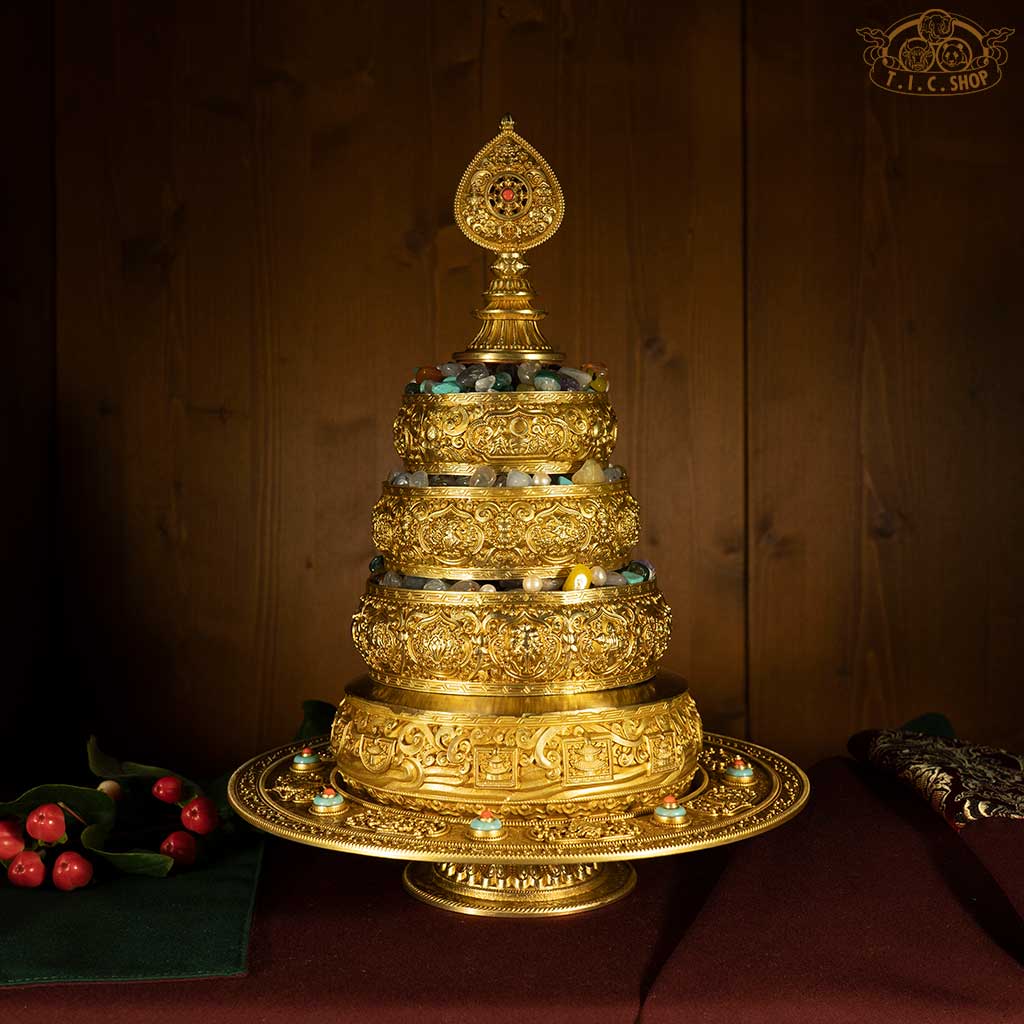
Traditional mandalas are often made of brass or copper alloys. These metals are stable, durable, and suitable for long-term use. The repeated handling and friction creates a patina reflective of time and human touch.
A complete mandala set consists of three parts:
-
Base plate: this symbolizes the earth and support. It is the foundation of all offerings.
-
Stacked rings: layered one above another, these represent the unfolding and stratification of the world.
-
Top finial: symbolizes the completion and perfection of the offering.
When do we use a mandala?
In Himalayan Tibetan households and monasteries, mandalas are used for grand ceremonies and even in daily practice. Often placed on a table, a mandala serves many purposes:
-
Daily mandala offerings as part of liturgical recitations
-
Accumulating merit and purifying obstacles in preliminary or retreat practices
-
Long-term, continuous personal practice
The mandala in practice
Practitioners place offerings on each layer, traditionally rice or grains, or symbolic substitutes as precious stones, and recite corresponding verses to complete a full mandala offering. This guides the practitioner’s mind back to generosity and awareness through clear and steady repetition, without the need for elaborate rituals. The placement of the top finial marks the conclusion and dedication of the offering.
Although the process relies on simplicity, it requires patience and focus. Through these repeated mindful actions, practitioners release their attachments. What may appear as a simple gesture to the observer is actually a conduit to inner cultivation of the Dharma.
Mandalas accompany their practitioners for many years and are passed down through generations. Embedded within them are the countless moments of deep spiritual practice of their holders.
An offering not yet complete
An offering is not an act to be hurried; it is a process that unfolds when the conditions are complete.
In our store, this mandala top waits for its reunification. Each day that passes, we sincerely hope that the bell will ring announcing her return and allowing for the fulfillment of her own complete and perfect offering.
Some objects are not forgotten, they are merely waiting for accumulated conditions to converge.
May all offerings ultimately reach completion.