
As winter fades and spring returns, ushering in a new cycle of time, we welcome the Year of the Fire Horse.
Chinese Lunisolar Calendar: February 17, 2026
Tibetan Calendar: February 18, 2026
The Year of the Fire Horse unites the dynamic qualities of Fire with the powerful symbolism of the Horse. It is regarded as a year filled with action, transformation, and vibrant life force.
The Correspondence Between the Twelve Zodiac Animals and the Five Elements
The Twelve Zodiac Animals combine with the Five Elements to form a complete sixty-year cyclical system of time.
This means that while the Year of the Horse returns every twelve years, the Year of the Fire Horse appears only once every sixty years. The previous Fire Horse year was 1966; after 2026, the next will be in 2086. Each time an animal sign returns, it is paired with a different elemental force, creating a distinct energetic quality and symbolic meaning for that particular year.
The Twelve Zodiac Animals and the Twelve Earthly Branches
 The Twelve Earthly Branches
Originally, these branches were used by the ancients to mark time—hours, months, and years.
Each branch is not only associated with a specific period of time, but also carries attributes such as one of the Five Elements, a cardinal direction, and a Yin or Yang quality.
The Twelve Zodiac Animals are essentially symbolic representations assigned to each of the Twelve Earthly Branches. Each animal represents a symbolic state of life expression:
Mouse — resourceful and intelligent; agility and adaptability
Bull — persistent and supportive; endurance and stability
Tiger — courageous and protective; strength and breakthrough
Rabbit — perceptive and diligent; refinement and awareness;
Dragon — innovative and creative; energy and transformation;
Snake — insightful and wise; calmness and profound
Horse — vital and free-spirited; movement and life force
Goat (Sheep) — gentle and harmonious; care and balance
Monkey — flexible and inventive; cleverness and ingenuity
Rooster — structured and clear-minded; order and expression
Dog — protective and trustworthy; loyalty and responsibility
Pig — abundant and inclusive; contentment and nourishment
The Five Elements and the Ten Heavenly Stems

The Ten Heavenly Stems
Essentially, the Ten Heavenly Stems represent paired expressions of the Five Elements, with each element having two stems—one Yang stem and one Yin stem.
The Five Elements describe five fundamental modes through which natural energy manifests and transforms:
Wood — growth, expansion, initiation
Fire — transformation, warmth, awareness
Earth — grounding, stability, balance
Metal — consolidation, refinement, order
Water — flow, nourishment, potential
The cyclical combination of the Ten Heavenly Stems and the Twelve Earthly Branches generates sixty unique pairings. This system is known as the Sexagenary Cycle (the Sixty Jiazi) — the foundational chronological cycle of the traditional Chinese calendar system.
The Tibetan Losar of the Fire Horse
In the course of its historical development, the Tibetan calendar incorporated the Chinese sexagenary cycle system, while also integrating elements from Indian calendar science and indigenous Tibetan astronomical traditions. Over time, it evolved into a distinctive system of year reckoning based on the Kalachakra (Wheel of Time) calendar.
Like the traditional Chinese calendar, the Tibetan calendar uses the sixty-year cycle of the Ten Heavenly Stems and Twelve Earthly Branches to designate years. The Tibetan Year of the Fire Horse corresponds structurally to the Chinese Bingwu (Fire Horse) year. The difference lies not in the cyclical designation itself, but in the calendrical calculations and the starting point of the New Year.
The Tibetan Losar does not always coincide with the Chinese New Year. Their relationship falls into four possible patterns:
- The two New Years coincide exactly.
- The Tibetan Losar falls one day later.
- The Tibetan Losar falls one month later.
- The Tibetan Losar falls one month and one day later.
The Cultural Symbolism of the Horse

In traditional culture, the horse represents momentum, strength, and freedom. It is a symbol of time in motion and the embodiment of speed, expressing dynamic action and the courageous pursuit of one’s goals. In every Year of the Horse, people often hope that their careers, studies, and personal lives will advance with the same vigor and swiftness as a galloping steed.
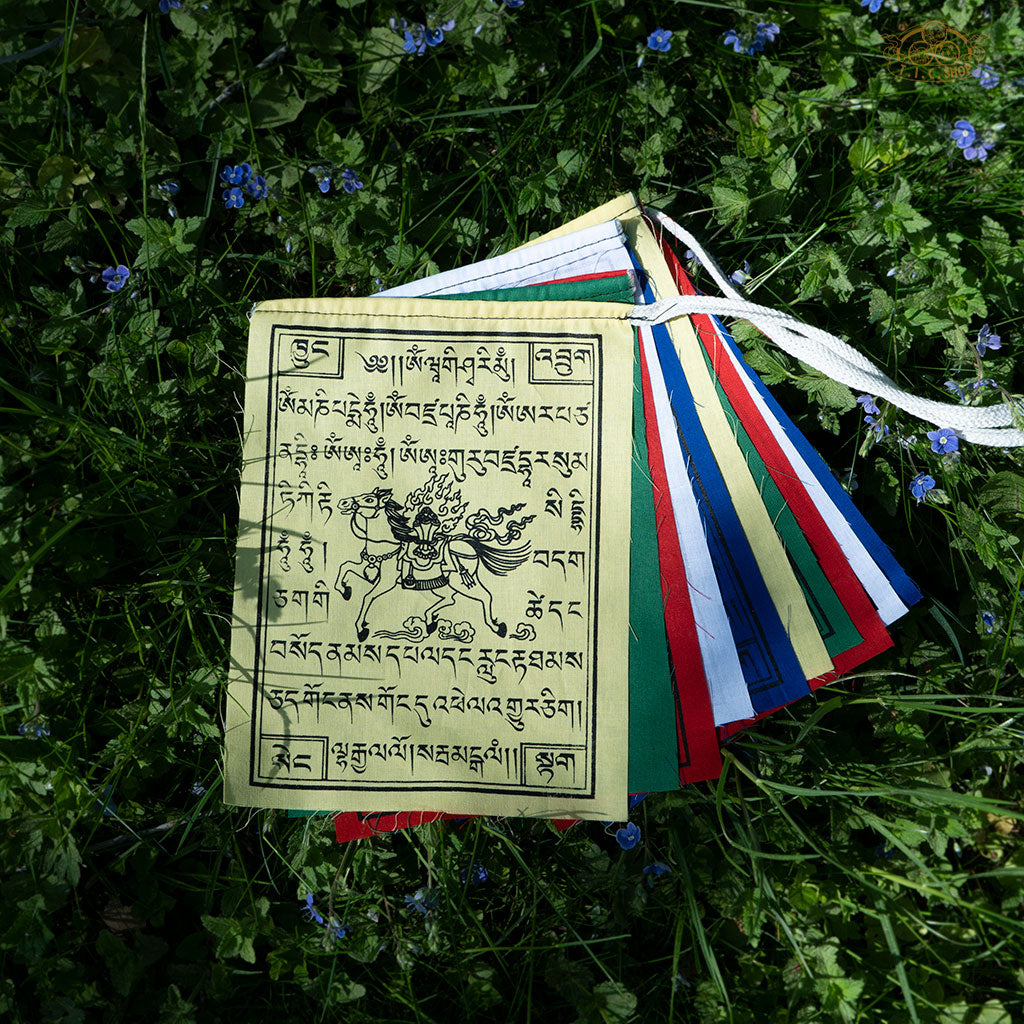
Horses hold a special spiritual significance for Tibetans. It is associated with wind, long journeys, and the Lungta (Wind Horse) prayer flags. The horse depicted on these flags symbolizes the power to carry aspirations and transmit blessings across space. For this reason, the arrival of a Horse year often evokes deeper reflections on the movement of fortune and the vitality of life itself.
In Tibetan regions, the Horse year is considered a year in which merit is believed to be multiplied. Therefore, many devotees choose to undertake pilgrimages and sacred circumambulations during a Horse year, viewing it as an especially auspicious time for spiritual practice.
The Meaning of the Fire Element: Transformation and Awareness
Fire symbolizes passion, vitality, transformation, and dynamic energy. It represents change and breakthrough — the inner force that propels growth and development.
Within Tibetan cultural and Buddhist symbolic systems, fire commonly signifies:
Transformation and purification
The warmth and vitality of life
The fire of wisdom that illuminates ignorance
Fire embodies creative power, yet it also serves as a reminder of the importance of awareness and balance.
When harnessed skillfully, the energy of fire can initiate meaningful change and inspire progress. When unbalanced, however, it may manifest as restlessness, impulsiveness, or depletion.
In the Year of the Fire Horse 2026, we are called not only to move forward, but also to turn inward in reflection. Forward movement requires strength — yet true strength arises from inner stability, awareness, and goodwill.
In traditional wisdom, each year offers an opportunity to recalibrate the relationship between ourselves and the world.
To experience how Tibetan families welcome the New Year in daily life, read our feature blog, Losar – Tibetan New Year.
| Original artworks © 2026 tibetboutique.eu